
ChatGPT Product Listing: How to Get Your Products Listed on ChatGPT (2026)
If you run a Shopify store, ChatGPT is now a shopping channel. Users ask it for product recommendations. It answers with real products. If yours aren’t in there, you don’t exist for that shopper.
Getting listed isn’t complicated. You need three things: an open robots.txt, a clean product feed, and (optionally) approval for ChatGPT Instant Checkout. Everything else is variations on those three.
I’ve done this for the store I run and for consulting clients. This is the actual process, in the order I do it.
Why This Matters
ChatGPT is becoming a product discovery engine for millions of users. Listed products get a new, high intent traffic source. Unlisted ones are invisible to that shopper.
How ChatGPT Shopping Works
ChatGPT surfaces real-time shopping results by partnering with third-party product data providers, including:
These integrations let ChatGPT show titles, prices, availability, images and purchase links inside its answers, with no extra work on your side once the feed is flowing.
How to Get Your Products Listed on ChatGPT
1. Use a Supported Platform
Make sure your store is connected to a supported platform or product syndication network, such as:
- Shopify (with feeds connected to Klarna or Criteo)
- Klarna or Criteo merchant networks
- WooCommerce or BigCommerce
- SAP Commerce
If you’re using Shopify, look into your Klarna or Criteo integrations to confirm that your product feed is active and syndicating properly or check the robots.txt.
2. Optimize Your Product Feed
Since ChatGPT uses real-time data, your product feed must be:
- Accurate (title, image, price, availability)
- Well-written (keyword-rich, clear product descriptions)
- Updated regularly
That is what lets the model present your listings correctly. You can also build your own feed in Google Sheets and host it from there.
3. Track Performance
While ChatGPT itself doesn’t yet provide detailed analytics, you can monitor:
- Referral traffic via UTM links on your CRM
- Sales spikes after feature updates
- Performance data inside Klarna, Criteo, or Shopify dashboards
4. Make Sure Your Site Is Discoverable by ChatGPT
Before your products can show up, they need to be discoverable, which starts with not blocking OpenAI’s crawler, OAI-SearchBot. Think of it as Googlebot for ChatGPT: it indexes content for ChatGPT’s search and shopping results. Block it, even by accident, and your products are never surfaced.
What to do:
- Check your
robots.txtfile (go to yourdomain.com/robots.txt).
Make sure it doesn’t block OAI-SearchBot. If needed, explicitly allow it:
User-agent: OAI-SearchBot

Allow: /- Track traffic.
ChatGPT addsutm_source=chatgpt.comto outbound links. That means you can track referral traffic in Google Analytics or other platforms. - Rest assured:
OAI-SearchBot is only used to power search. It does not crawl your site for training OpenAI’s models.
Letting OAI-SearchBot in is step zero if you want your products to show up where people are actively shopping and searching in ChatGPT.
5. Submit Your Product Feed to ChatGPT
Have a feed that Shopify accepts, then submit the merchant application with your business details at chatgpt.com/merchants. That is also the route to Instant Checkout.

Understanding Discovery vs. Instant Checkout
There are two different ways your products can show up in ChatGPT, and it helps to know which one you’re aiming for:
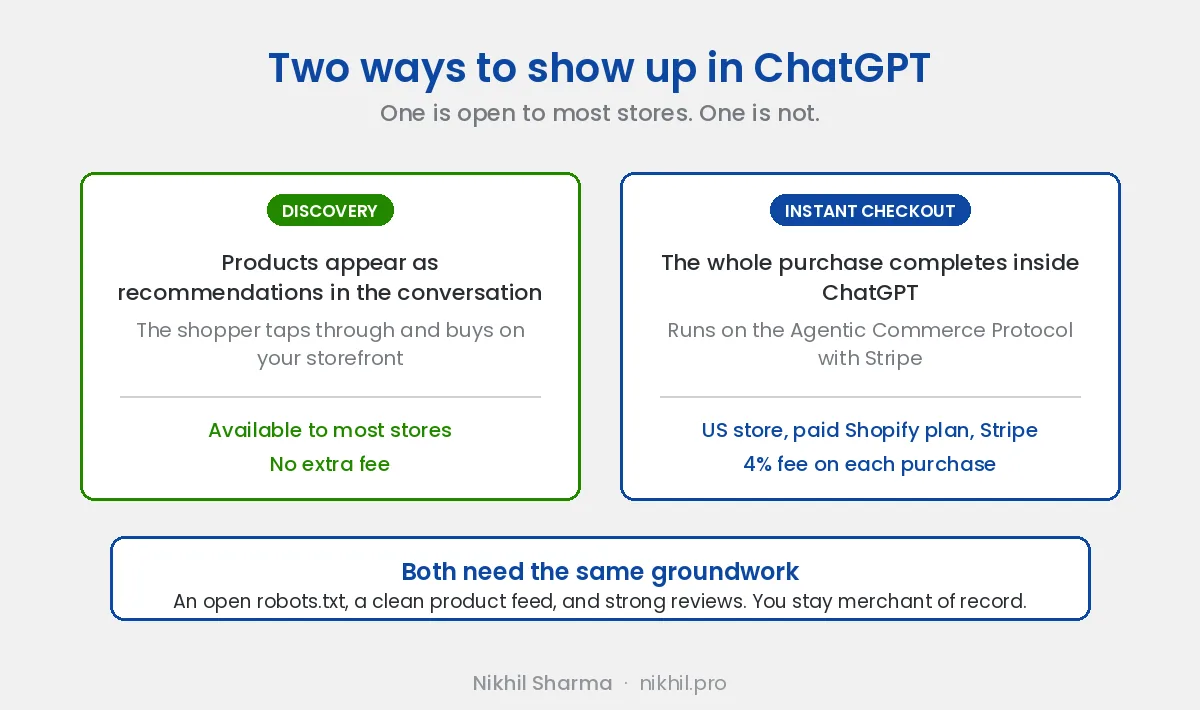
- Product discovery: your products appear as recommendations inside a conversation, and the shopper taps through to buy on your storefront. Available to most stores.
- Instant Checkout: the shopper completes the purchase inside ChatGPT without leaving the chat. More restricted.
Instant Checkout runs on the Agentic Commerce Protocol (ACP), co-developed by OpenAI and Stripe. Payment flows through Stripe using a Shared Payment Token, so ChatGPT can process the order without ever seeing the buyer’s card details. You stay the merchant of record and keep handling fulfilment and returns through your existing systems.
A realistic note on eligibility: in chat checkout is still limited. After the early rollout with Etsy and a few brands, OpenAI narrowed the program, and only a small number of Shopify merchants are live with it. For most stores the winning move is to get discoverable first, an open robots.txt, a clean feed and strong reviews, so you are ready when Instant Checkout opens to you.
What It Costs
OpenAI charges merchants 4% on each completed Instant Checkout purchase; shoppers pay nothing extra. Recommendations are organic, so relevance decides which products surface, not ad spend. That favours smaller brands with well structured feeds and good reviews.
Claim Your Business in ChatGPT’s Business Hub
Since 10 November 2026 there is a second thing to do alongside the feed: claim the business itself. OpenAI’s Business Hub sits in the ChatGPT sidebar on the web (chatgpt.com/business-hub), and a claimed, verified business gets a profile it controls, a product feed connection, the first organic visibility data OpenAI has ever shown, and in the US a business agent. It is free. Here is the process as it runs today, and what each step unlocks; the full Business Hub guide has the terms and the edge cases.
Two approvals, not one. First you prove you are connected to the business, then you prove who you are.
- Find or add the business. Search for it in the Hub and select it. An online business ChatGPT does not list yet can be added. Local stores and restaurants can only claim an existing listing, and only in the US for now.
- Prove the connection. The Hub offers whichever of these apply: a code sent to the business phone or business email, a TXT record on the domain, or connecting the Shopify store. If you have the DNS login, use the TXT record; it is the one route that does not wait on somebody’s inbox.
- OpenAI reviews the claim and emails a decision.
- Identity check through Persona. Government ID, business registration details and proof you are authorised to act for the business, matched against official records. Until this passes you cannot publish profile edits, connect a product feed, see Insights or create an agent, and the verified badge does not show. Persona currently fixes the country to the US and cannot be changed once that step is passed, which is the main complaint from businesses outside the US.
What a verified business can do.
- Edit the profile: website, description, category, logo, cover photo, delivery and return policies. OpenAI reviews edits before they publish, and a published profile cannot be deleted, unpublished or hidden afterwards, even by support; only drafts can be removed. Read the terms before claiming: the licence to the basic information you submit is perpetual, and there is a broad release of claims over your business data and site content. For a client, have their lawyer read it.
- Connect the product feed. CSV or JSONL in OpenAI’s specification, 48 fields with 9 required, or the Shopify connection, which syncs the catalogue. A plain file upload targets the US; other markets need OpenAI to confirm the integration first. Sale and availability dates in the feed do not schedule anything, so update the file when prices change.
- Read Insights. Past 28 days: mentions, website clicks and discovery topics. For an online business a mention counts only when ChatGPT references your website, not when it says your brand name. Prompts are never shown, and the numbers stay blank until activity passes a threshold, so blank does not mean zero. This is the first view OpenAI has given of how a business shows up in unpaid answers; ads data has been in Ads Manager since May.
- Create a business agent (US ecommerce and online service businesses with a website, eligibility reviewed separately). It answers from your information in a separate labelled conversation, cannot complete purchases, make bookings or look up orders, is reviewed by OpenAI on every update, and can be used as the destination for a ChatGPT ad.
Who should claim it. The owner, because whoever claims becomes the admin and the admin adds teammates and agencies, each signing in with their own ChatGPT account. An agency claiming on a client’s behalf puts the client’s business under the agency’s identity check. Brands are claimed separately; claiming a parent does not claim its locations.
How to Show Products Reviews on ChatGPT

You can use an app like Judge.me to show your product reviews on ChatGPT.
Does ChatGPT support Shopify product feeds?
Yes, ChatGPT supports Shopify Product feeds
You submit a feed (a product XML or Google Merchant feed) directly to OpenAI, and the crawler fills in the rest from what is public on your site. That is why well structured product pages and an open robots.txt matter as much as the feed.
Who Sees Your Products?
This feature is currently available to everyone with browsing enabled (GPT-4-turbo) including ChatGPT Atlas browser. As the rollout continues, more visibility is expected across platforms.
Watch the Video
I have also made a video tutorial of the article
Final Tips
- Keep inventory synced and avoid out-of-stock listings.
- Use high-quality images and SEO-friendly product names.
- Monitor results using Google Analytics and refine your product titles/descriptions based on performance.
Get the Free AI Shopping Checklist
The tactical version of this post, plus the fixes for Perplexity, Google AI Overviews and Gemini, is a free PDF: get the AI Shopping Checklist. Six sections, doable in an afternoon, no course and no upsell.
This post is about what ChatGPT can show a shopper. The opposite direction, letting it answer questions about your own sales, is a different build: connecting Clover POS to ChatGPT with an MCP server.
Or Book Your ChatGPT Product Listing Audit
If you would rather not implement it yourself, I audit a store’s AI visibility end to end on a paid call.
The paid side of the same channel, OpenAI’s own Ads Manager, is in the ChatGPT ads review: what you can target, the character limits, and what a Meta buyer will not find.
Done with you, on a call
AI visibility audit for your store
Feed, schema, llms.txt, crawler access and Merchant Center checked end to end, with a written fix list. Price and scope on the booking page.
Prefer to do it yourself
The ChatGPT shopping checklist
The same checks as a worksheet, with the application links and the parts OpenAI's docs leave out.
Shopify now ships part of this by default: an llms.txt file and agentic endpoints on every store, covered in Shopify’s agentic commerce rollout. The protocol fight over who owns the product data underneath is in what Google’s UCP means for Shopify brands.
Frequently asked questions
Should an agency claim a client's business in ChatGPT?
What does ChatGPT Business Hub Insights show?
How do I claim my business in ChatGPT?
Is there a tool that shows whether my products appear in ChatGPT shopping?
How do I get my products listed on ChatGPT?
Is listing products on ChatGPT free?
What is the difference between ChatGPT product discovery and Instant Checkout?
How do I submit a product feed to ChatGPT?
Does ChatGPT read Shopify product feeds directly?
Why are my products not showing up in ChatGPT?
Do reviews affect whether ChatGPT recommends a product?
Can a non US Shopify store be listed on ChatGPT?
Part of AI search and agentic commerce, where every guide on the subject is listed in reading order.
Get new posts in your inbox
Occasional notes on Shopify, paid ads, and what I learn. No spam.
Thanks. Check your inbox to confirm.

Nikhil Sharma
Nikhil Sharma runs data and operations for a DTC brand on Shopify and consults for Shopify brands on Meta and Google ads, conversion and AI automation. He writes case studies and implementation guides from accounts and systems he has run himself.